Showing posts with label intersection. Show all posts

Saturday, August 18, 2012

A Driving Primer for Connecticut Drivers, Part 3

This primer is presented somewhat tongue-in-cheek, but it is inspired by the actual activity I've seen on the roads since moving to Connecticut. To be fair, it may just be the greater New Haven drivers that really need this primer, as I hear that even Massachusetts drivers think New Haven area drivers are terrible. One legal-ish note: none of the images used here are mine. Click on an image to see where I've linked to it from and any copyright information that may be included.

Part 1 of this driving primer focused on the confusing lines in the road that run parallel to the road itself. Part 2 focused on those weird color-changing "traffic" lights and two types of lines that run across the road: stop lines and crosswalks.

Part 3: Stop Signs and Unmarked Intersections
If you've driven much at all then you're probably come across one of those weird 8-sided red signs with the enigmatic message "STOP" written on them in white letters. Though many feel that these signs are ambiguous at best, we'll unravel the mystery of what they mean here. We will also tackle the difficult problem of what to do when two streets cross each other but there are no "traffic" lights and none of these "STOP" signs.
  • Stop signs "STOP" signs (or simply, stop signs) seem to be everywhere. To many drivers (and to even more bicyclists, but that's another post), they simply have no meaning and can be ignored. Here's a typical stop sign in the wild:

    To begin to unravel the mystery of what to do when confronted with one of these signs, I started by trying to find out what the acronym "S.T.O.P." stood for. Much to my surprise, I discovered that it is not an acronym, but an actual English word! The word has many definitions, but the one that seems the most relevant in a driving situation is this: "To cease moving, progressing, acting, or operating; come to a halt." This makes it clear what one must do when confronted by a stop sign; one must come to a halt. But where? Most stop signs come paired with a stop line (see part 2 of this primer).
    The stop line in the above image is a bit worn, but it's there. When a stop line is provided, treat it just like a stop line at a traffic light: stop there. Not 15 feet before you reach it. Not after your car has crossed it (and therefore entered the intersection). Stop so that the front of your car is at the stop line and the rest of the car has not yet crossed it. If there is no stop line then stop before the front of your car enters the intersection. (I placed emphasis on the word "before" because so many people seem to miss it.)

    Once you have stopped your vehicle, it is not necessary to remain stopped indefinitely. Instead, carefully look for the following: (a) other vehicles approaching the intersection whose route will intersect yours and who do not themselves have a stop sign and (b) pedestrians. As much as I joke about things being difficult, this looking for pedestrians bit is extremely important, yet seems to be missed by many, many people. I don't know how many times I've seen a pedestrian hit or nearly hit by a car because the driver was so busy peering around the pedestrian for traffic that they never even saw the pedestrian.

    Pedestrians have the right of way at intersections whether there's a crosswalk painted there or not. If someone is crossing the street, don't just stop right in front of them and figure they'll go around you. Stop far enough back that they can safely pass in front of your vehicle, let them do so, then move forward to where you can see oncoming traffic and stop again to look for traffic. (True story: I was crossing a street when a woman pulled up to the intersection, stopped before entering the crosswalk, looked me in the eye, then pulled forward inches in front of me to look for traffic and stopped. She was so close that I lost my balance trying to dodge around the back of her car and accidentally hit it with my hand as she started to drive off. She stopped (in front of oncoming traffic), rolled down the passenger window, and yelled, "That's how people get shot!" By getting cut off by a rude driver and losing their balance? Whatever.)
  • All way stops Many people are honestly confused about what to do with they approach an all way stop (frequently referred to as a 4 way stop, since most intersections have traffic traveling in four directions).
    All joking aside, all way stops are clearly very confusing for people, so here are the rules on how to handle an all way stop.
    • First, come to a stop just as you would with any other stop sign.
    • Look for traffic (and pedestrians!); if there is no other traffic then proceed on your way.
    • If another vehicle arrived at the intersection before you then they have the right to go first, so you must wait until they have gone before you go.
    • If two (or more) vehicles arrive at the intersection at the same time, then right-of-way is determined as follows:
      • The vehicle immediately to your right has right-of-way over you. You must wait until that vehicle has gone before you go.
      • It follows from the above that you have right-of-way over the vehicle to your left. Make eye contact with the other driver (if possible) and make sure that they are yielding that right-of-way to you, then proceed if it is otherwise safe.
      • If the other vehicle is coming the other direction then right-of-way only matters if one or both of you is turning left (or otherwise crossing the other's path). In that case, any vehicle going straight or turning right has the right-of-way and the left turner must yield.
    • Sometimes you come to an all way stop to find that there are lines of vehicles waiting in all directions. This is a situation in which many drivers are confused and don't know what to do. The important thing here is to take turns. To determine who goes next, figure arrival time at the intersection to be when each vehicle reaches the front of the line and use the right-of-way rules described above.

    One final important comment related to all way stops: if you come to a traffic light that is either completely nonfunctional (dark) or which is flashing red in all directions then that traffic light is an all way stop. These can be difficult to navigate if it is a large intersection with multiple lanes going in each direction. Here, again, turns should be taken, with all vehicles traveling in a certain direction going at the same time. One vehicle from each lane should go with each "turn". There should not be multiple vehicles from the same lane going through the intersection at the same time, I don't care how frustrated the drivers are or how long they've been waiting; others have also been waiting and are probably just as frustrated. You're all in that situation together, so cooperate to get through it safely.
  • Unmarked intersections Also known as "uncontrolled" intersections, these are intersections with no stop lights or traffic control signage whatsoever.
    Having learned the rules for all way stops above, unmarked intersections should be a breeze: the only difference is that you don't have to stop before going through the intersection if there is no other vehicle with right-of-way over you. That emphasized part is the part that a lot of people don't seem to realize. You do need to slow down enough when approaching an unmarked intersection to determine whether or not (a) you have the right-of-way and (b) if it is, in fact, safe to go through the intersection. Not checking for both of these things leads to this:
    This accident occurred in an unmarked intersection. None of the three drivers involved was paying attention to cross traffic. Luckily, no one was seriously hurt, but the drivers of the Cavalier and Jeep got free trips to the hospital and the driver of the truck got to explain to his boss why he totaled a company car when he could have prevented the whole accident just by glancing to his right.

    There is one important situation in which an unmarked intersection does not have the same right-of-way rules as an all way stop. This is at a "T" intersection (i.e., one of the roads ends at the intersection while the other continues on).
    In this situation, the car on the road that ends (the red car above) is required to yield to all vehicles on the road that continues through (the blue and yellow cars above).
Thus ends my driving primer for Connecticut drivers. Since this is just a primer, I haven't touched on more advanced topics such as yield signs (HINT: they are not the same as stop signs, but the right-of-way rules are the same) and merging into freeway traffic (HINT: it is very dangerous to try to merge at 40 mph when the traffic is traveling 60-80 mph--ramps and acceleration lanes are there for a reason). We now return you to your irregularly unscheduled blog posts.

Thursday, July 26, 2012

A Driving Primer for Connecticut Drivers, Part 2

This primer is presented somewhat tongue-in-cheek, but it is inspired by the actual activity I've seen on the roads since moving to Connecticut. To be fair, it may just be the greater New Haven drivers that really need this primer, as I hear that even Massachusetts drivers think New Haven area drivers are terrible. One legal-ish note: none of the images used here are mine. Click on an image to see where I've linked to it from and any copyright information that may be included.

Part 1 of this driving primer focused on the confusing lines in the road that run parallel to the road itself.

Part 2: Traffic Lights, Stop Lines, and Crosswalks
One particularly difficult item that drivers must deal with during almost any drive is what to do at a traffic light or intersection. The rules seem vague or pointless, but they really are very specific. In this part of our driving primer, we uncover just exactly what these rules tell you to do in nearly any situation.

  • Traffic lights We will focus on how traffic lights work in the United States, since this primer is aimed at Connecticut drivers, and Connecticut spends the vast majority of its time in the U.S.A. Traffic lights in other countries sometimes behave differently (even as nearby as Canada, where there is a flashing green), but covering everything would be confusing.

    Traffic lights in the United States may typically be found in one of three states, as shown below (shamelessly clipped from a Wikipedia article which is, ironically, about how traffic lights work in the United Kingdom):
    Note the explanation of each of the figures.

    Figure 1's explanation says that a red light means stop. This means that if the traffic light looks like figure 1 before you and your vehicle enter the intersection then you must stop your vehicle and wait for it to look like figure 2 before going through. It does not mean that 4 or 5 more vehicles should go through the intersection even though the right light is showing, in spite of what many drivers in the New Haven area clearly believe. This is one of those places where the rule is actually very clear (you must stop and wait) but that common interpretation (you might stop, but if you're in one of the first "few" cars then it's okay to go through) makes it seem more confusing than it really is.

    There is one situation where you do not need to wait for the light to resemble figure 2 before proceeding: the "right turn on red", or "free right turn". The rule is still very clear about this, however. You must stop before making the turn. You stop your vehicle and carefully look to make sure no traffic is coming towards you before making the turn. Some motorists seem to think that simply coasting for a moment and then turning without looking for oncoming traffic is okay. It is not. The main rule is really very simple: if the red light is glowing then you must stop your vehicle. Important note: The presence of a sign that says "NO TURN ON RED" means that you are not allowed to perform a "right turn on red" maneuver. In that case, you must stop your vehicle and wait for the green light to glow before making your turn.

    I now bring your attention to figure 3; the yellow (or "amber") light glowing. This state occurs just after figure 2 and just before figure 1. It is a warning to you that the red light is about to start glowing, so you should prepare to stop. In Connecticut, it appears that many motorists are not aware that this state is any different from the state shown in figure 2. In a sense it isn't: if you're already passing through the intersection (or just entering it) when the amber light comes on then you may continue through. Otherwise, you should prepare to stop since the red light will come on shortly. (Side note: in many states, including my native Washington (the state, not D.C.), drivers seem to believe that figure 3 means "go really, really fast so you don't have to stop when the red light comes on". It turns out that this is also incorrect as, if anything, you should slow down when the amber light is lit, not speed up.)
  • Stop lines and crosswalks 
    • Stop Lines The solid white lines that go halfway across the road on each side of this intersection (see the image below) are called stop lines. When approaching the intersection, if the light facing you is showing red (see figure 1, above), then stop your vehicle before crossing this line. Your vehicle should not be across the line, even part way, when you come to a stop. What you should definitely not do is stop with the stop line behind you. If you have done that then you are (by definition) in the intersection.


      Sometimes, the stop lines seem to be set way back from the intersection itself. Take, for example, the stop line on the right in the image above. That stop line is so far back for a very good reason: buses and other large vehicles traveling north (upwards in the image) frequently turn right at that intersection. If you don't stop before your vehicle crosses that line then they will be unable to turn the corner without hitting your vehicle (which the bus drivers in Connecticut have no problems with doing). If you see a stop line that seems unreasonably far back from the intersection then it is back there for a reason. Stop there anyway.
    • Crosswalks Crosswalks are places where people walking, jogging, or otherwise moving themselves along with their feet (we'll call these people "pedestrians")  are supposed to be able to cross the street safely and without vehicles in their way. A crosswalk can be identified by two white lines several feet apart perpendicular to the road and all the way across the road. In the image above, there are two crosswalks: one on the road coming in from the right and one at the bottom of the intersection. Note how these crosswalks are lined up with the sidewalks for the convenience of the pedestrians (who should be using the sidewalks). Note also that the crosswalks are beyond the stop lines. In other words, if you stop at the stop line then you are in no way blocking the crosswalk with your vehicle. You should never stop your vehicle in a crosswalk (unless not doing so would cause an accident, of course). The crosswalk is part of the intersection, so stopping in the crosswalk is just like stopping right in the middle of the intersection: it's rude, dangerous, and illegal.

      Little known fact: In spite of how they are spaced, the point of the lines for crosswalks is not to stop with your front wheels on one line and your rear wheels on the other. While this is a fun and exciting game to play in the privacy of your own backyard, it is dangerous, rude, and illegal to do so on public roadways.

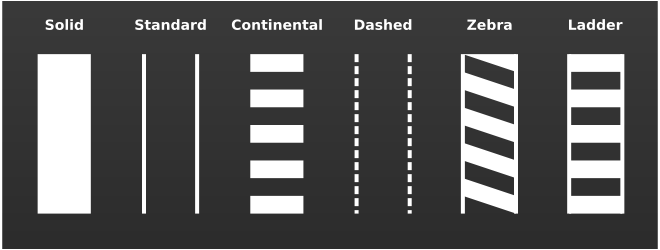
      Crosswalks can be marked in many different ways. I focused on the "standard" style of crosswalk above, but crosswalks can actually be marked in many different ways, as shown in the image below:

      Any of these can be used to indicate a crosswalk, so watch out for any of them.
      One final important note about crosswalks: they don't always occur at intersections. When you encounter a crosswalk in a location with no intersection (or special traffic light), look before driving through the crosswalk to see if any pedestrians are either (a) currently in the crosswalk or (b) at the edge of the road and appearing to wish to use the crosswalk. If either one of these conditions is met then stop your vehicle before beginning to go through the crosswalk and wait for the pedestrian(s) to finish using the crosswalk before continuing. The white car in the picture below is doing it wrong. (The pedestrian in this picture is a policeman, by the way. Just something to think about.)

      The cars in this picture, on the other hand, are doing it right at the very same crosswalk. (Note that this crosswalk is not at an intersection.)
Stay tuned for the third (and, I think, final) part of this primer: stop signs and unmarked intersections. Coming soon!